

A tiny number written after a decimal point can sometimes feel like a little puzzle sitting on a classroom desk. A student may look at 0.04 and wonder, “Is this a very small number? How do I write it as a fraction?
Why does it become something completely different?” These questions are actually the beginning of understanding how numbers speak different languages.
A Decimal and a Fraction are simply two ways of showing the same mathematical idea, and learning how they connect can make many future math lessons much easier.
I still remember a story shared by a parent helping a child with Math Homework at a kitchen table. The child had written “0.04 = ?” and felt stuck.
The parent grabbed a chocolate bar and divided a small piece into equal sections, showing that even tiny amounts can have a clear meaning. That little moment turned a confusing worksheet into a friendly Math Lesson.
Sometimes mathematics clicks not because the rule is complicated, but because someone explains it in a way that feels real.
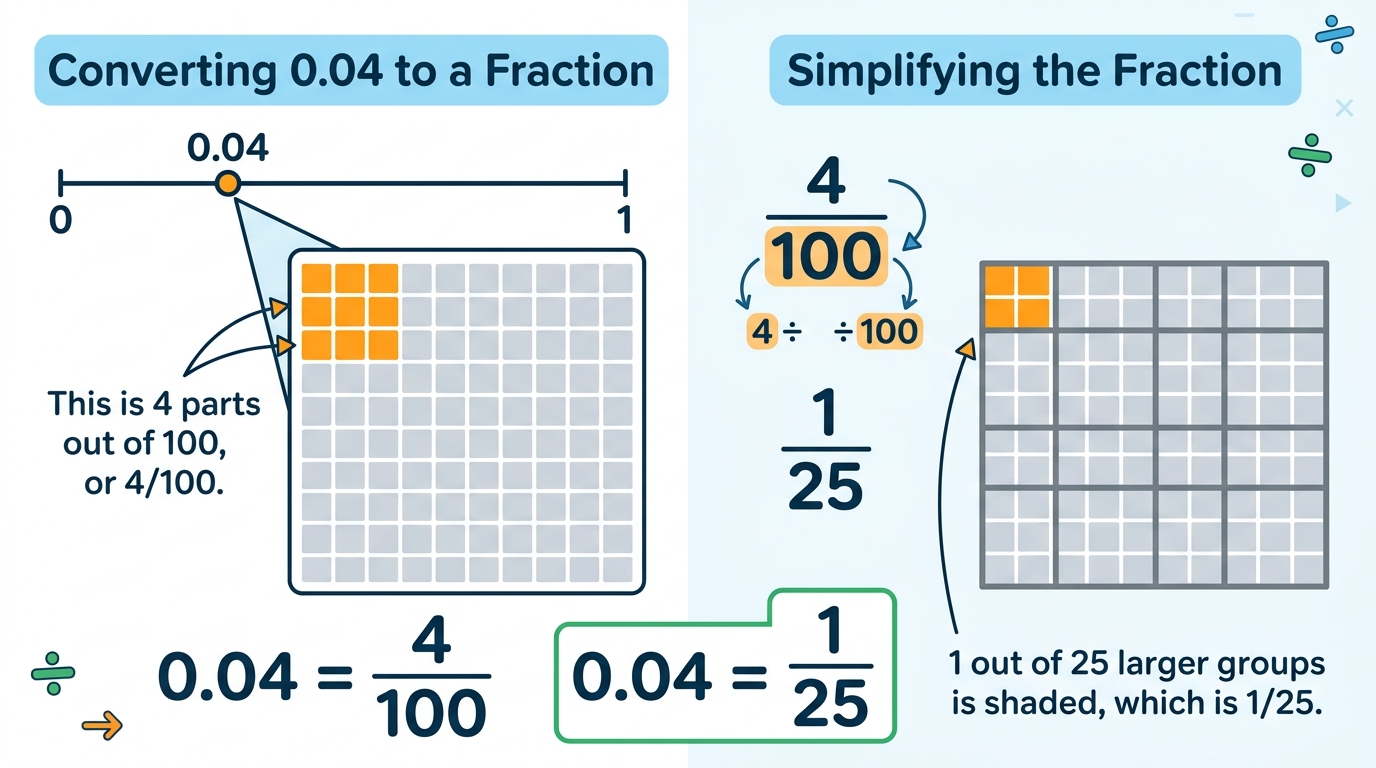
So, what is 0.04 as a fraction? The answer is 1/25. The original Decimal Representation is equal to 4/100, and after Fraction Simplification, it becomes 1/25 in Simplest Form or Lowest Terms.
This article explains how to convert 0.04 to a fraction, why the answer is 1/25 fraction, and how students, parents, and teachers can understand the process through simple examples.
The numbers may be small, but the learning behind them is actually pretty big.
| Step | Result |
|---|---|
| Decimal | 0.04 |
| Write as a fraction | 4/100 |
| Simplify by dividing by 4 | 1/25 |
| Simplest fraction | 1/25 |
| Equivalent percentage | 4% |
Understanding What 0.04 Means in Decimal Form
Before learning 0.04 as a fraction, it helps to understand the Decimal Number itself. The number 0.04 uses Decimal Notation, where the digits after the decimal point represent parts of a whole.
The first digit after the decimal point represents tenths. The second digit represents hundredths. Since 0.04 has a 4 in the second decimal place, it means four hundredths.
In other words:
0.04 = 4 hundredths = 4/100
The Place Value system is the key here. The decimal point acts like a small doorway separating whole numbers from smaller pieces of numbers. It might seem simple, but this idea is one of the most important building blocks in Elementary Mathematics.
A teacher explaining this to a child might say, “Imagine a whole pizza cut into 100 tiny equal slices. Four slices would represent 0.04.” Sounds easy, right? That picture helps many learners understand why the denominator becomes 100.
The Decimal Place Value tells us the correct denominator when we write a decimal as a fraction. A decimal with one number after the point usually becomes a fraction over 10. A decimal with two numbers after the point becomes a fraction over 100.
Examples:
- 0.5 = 5/10
- 0.25 = 25/100
- 0.04 = 4/100
These are examples of a Terminating Decimal, meaning the decimal ends instead of continuing forever.
What is 0.04 as a Fraction in Simplest Form?
The question “what is 0.04 as a fraction in simplest form” has a simple answer:
0.04 = 4/100 = 1/25
The first fraction we create is not always the final answer. In mathematics, we often need to reduce or simplify fractions. This process is called Fraction Simplification or Reduction.
To simplify 4/100, we need to find a number that divides both the Numerator and the Denominator.
The numerator is the top number:
4/100
The denominator is the bottom number:
4/100
The Greatest Common Factor (GCF) of 4 and 100 is 4. Some books call this the Greatest Common Divisor (GCD) too. They mean almost the same thing in this situation.
Now divide both numbers by 4:
4 ÷ 4 = 1
100 ÷ 4 = 25
So:
4/100 = 1/25
Therefore, the Fraction Representation of 0.04 is:
1/25
This is the Simplified Fraction and the correct answer in Lowest Terms.
How to Convert 0.04 Into a Fraction Step by Step
Many students search for “how to convert 0.04 into a fraction” because they want a method they can use again and again. The good news is that the process works for many decimal numbers.
Here is a simple Decimal to Fraction Conversion method:
- Write the decimal number without the decimal point.
- Count how many digits appear after the decimal point.
- Place that number over 10, 100, 1000, or another power of ten.
- Simplify the fraction.
For 0.04:
The decimal has two digits after the decimal point.
So the denominator becomes 100.
0.04 becomes:
4/100
Then simplify:
4/100 ÷ 4/4 = 1/25
The final result:
0.04 written as a fraction = 1/25
This is called the Place Value Method because it uses the value of each decimal position.
Another way is the Division Method. Since fractions represent division, 1/25 means 1 divided by 25, which gives 0.04. The two forms are simply different views of the same Rational Number.
Why Does 0.04 Equal 1/25?
A common question from learners is, “Why is 0.04 equal to 1/25?” It feels strange at first because 4/100 looks larger than 1/25.
The answer is that they are Equivalent Fractions.
Imagine sharing a bowl of rice at a family meal. One person may receive 4 portions out of 100 tiny portions, while another way of sharing could describe the same amount as 1 portion out of 25 equal portions.
The amount has not changed, only the description has changed.
Mathematics often works like this. A number can have different appearances but the same value.
Some related examples:
- 0.05 as a fraction = 5/100 = 1/20
- 0.08 as a fraction = 8/100 = 2/25
- 0.2 as a fraction = 2/10 = 1/5
These examples help students notice patterns and improve their Math Practice.
Teaching 0.04 as a Fraction to Children
Learning fractions and decimals can feel confusing for a child, especially when the symbols look unfamiliar. A good parent or teacher focuses on pictures, objects, and everyday experiences.
A teacher named Janice S. Armas once described learning as something that grows through patience and practice. This idea fits mathematics too. Children do not always understand a formula the first time, and thats completely normal.
Here are some friendly teaching ideas:
- Use a number line to show where 0.04 belongs.
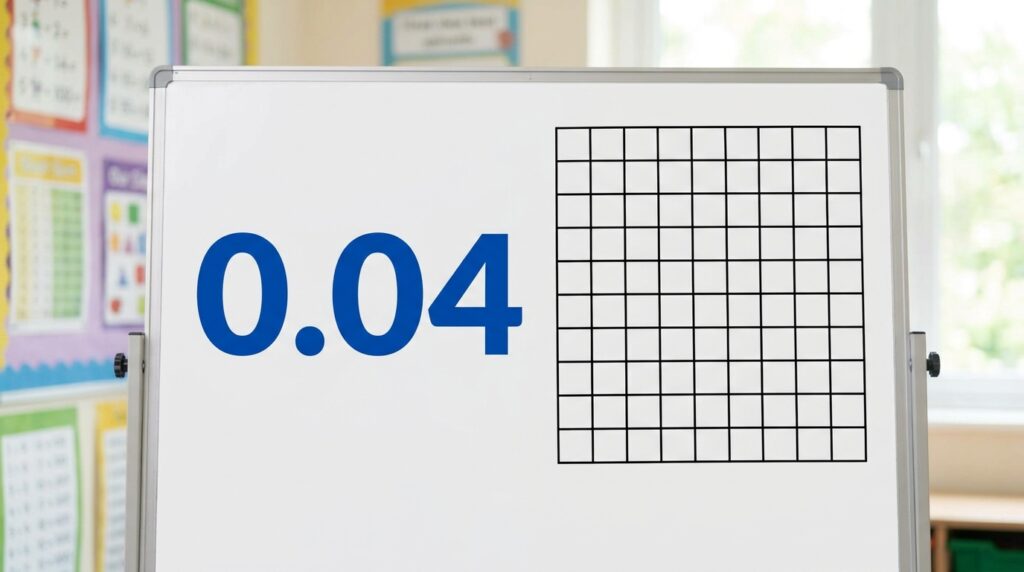
- Draw 100 small boxes and color 4 of them.
- Connect money examples, such as cents and dollars.
- Let children explain the answer using their own words.
- Use fraction exercises that start with simple examples.
Visual Learning can make Fraction Explanation much easier. When students see that 4 out of 100 parts are shaded, the connection between decimal and fraction becomes clearer.
Parents helping with homework may also use real life examples. A lunchbox divided into equal sections, a chocolate bar broken into pieces, or sharing snacks among friends can turn an abstract problem into something familiar.
Decimal Conversion Rules Students Should Remember
Understanding 0.04 fraction is part of a bigger group of Mathematical Concepts. Students eventually learn different types of decimals and fractions.
A few important ideas include:
- A Terminating Decimal stops after a certain number of digits, like 0.04 .
- A Repeating Decimal continues with a repeating pattern, like 0.3333…
- A Non Terminating Decimal does not end.
Not every decimal looks simple, but many decimals can still be written as fractions because they are Rational Numbers.
For example, decimal expansion helps us understand how numbers are built. The number 0.04 has a limited Decimal Expansion, making its conversion straightforward.
Learning these rules builds stronger Mathematics Skills. It also prepares students for more advanced topics like ratios, percentages, algebra, and more complex arithmetic.
Common Mistakes When Writing .04 in Fraction Form
Many students searching “.04 as a fraction” make small mistakes during conversion. These errors are very common, and they can be fixed with practice.
One mistake is writing 4/10 instead of 4/100. The reason is simple: some learners forget that 4 is in the hundredths place, not the tenths place.
Another mistake is stopping at 4/100 and not simplifying. While 4/100 is correct, the question may ask for the Simplest Form, which means the answer should be 1/25.
A few reminders:
- Always count the decimal places carefully.
- Identify the correct denominator.
- Look for common factors.
- Reduce the fraction when possible.
A Math Tutor often encourages students to check their work by converting the fraction back into a decimal. If 1/25 divided gives 0.04, the answer is confirmed.
Using 0.04 in Real Life Situations

Numbers like 0.04 are not just classroom examples. They appear in measurements, money, science, and everyday calculations.
A European grandmother teaching a child about sharing while knitting might explain fractions using small sections of yarn.
A Filipino family preparing food may use measurements that involve tiny portions. Different cultures have different stories, but the mathematical idea stays the same.
Fractions help people describe parts of a whole. Whether measuring ingredients, dividing materials, or understanding discounts, these skills are useful beyond school.
Even a tiny amount like 0.04 has meaning. It represents a real portion, a real value, and a real relationship between numbers.
A Quick Summary: 0.04 in Fraction Form
For anyone needing a fast fraction explanation, here is the complete solution:
0.04
Move the decimal two places to create a fraction:
4/100
Find the GCF of 4 and 100:
GCF = 4
Divide numerator and denominator by 4:
4 ÷ 4 = 1
100 ÷ 4 = 25
Final answer:
0.04 as a fraction = 1/25
This is the 0.04 in lowest terms and the simplest fraction for 0.04.
Frequently Asked Questions
What is 0.04 as a fraction?
0.04 as a fraction is 1/25. You can find this by writing 0.04 as 4/100 and simplifying it by dividing both numbers by 4.
How do you convert 0.04 into a fraction?
Write 0.04 = 4/100, then simplify by dividing the numerator and denominator by their greatest common factor (4). The result is 1/25.
Is 1/25 the simplest form of 0.04?
Yes. 1/25 is the simplest form because 1 and 25 have no common factors other than 1.
Why is 0.04 written as 4/100 first?
Because the decimal 0.04 has two digits after the decimal point, it represents 4 hundredths, which is written as 4/100 before simplifying.
Can 0.04 be written as a percentage?
Yes. Multiply 0.04 × 100, and you get 4%. This means 0.04, 4/100, 1/25, and 4% all represent the same value.
Read This Blog:https://zyrovexa.com/common-things-that-are-2-inches-long/
Conclusion: Making Decimal and Fraction Learning Easier
Understanding what is 0.04 as a fraction is a small lesson that teaches a much bigger idea: numbers can be represented in different ways. A Decimal Representation and a Fraction Representation may look different, but they can show the exact same value.
The journey from 0.04 to 4/100 and finally to 1/25 teaches important skills like Fraction Conversion, simplification, and mathematical reasoning. These skills become the foundation for future learning in school mathematics.
When teaching or learning fractions, remember that patience matters. A simple drawing, a kitchen table example, or a conversation with a caring teacher can make difficult topics feel friendly.
If you are helping a child, creating a math lesson, or practicing for homework, try explaining the idea in your own words. You can also share your favorite tricks for learning fractions and decimals with others.
Every small explanation adds another piece to the bigger picture of understanding mathematics.
Numbers may be quiet, but they tell stories. Even a tiny decimal like 0.04 has a story waiting to be discovered.