

There’s a funny little thing that happens when someone opens a binder full of Pokémon cards.
Before they notice the artwork, before they admire a shiny Charizard, before they even remember which card they traded away in fifth grade and still regret today, their hands already know the shape.
The size feels familiar. Almost like muscle memory. You hold one card and somehow your brain says, “Yep, that’s a Pokémon card.”
Yet surprisingly, many collectors never stop to ask about the actual Pokémon Card Dimensions. How tall are they exactly? How thick? Why do sleeves fit so precisely?
Why can a counterfeit card often be spotted by something as simple as a measurement that’s slightly off?
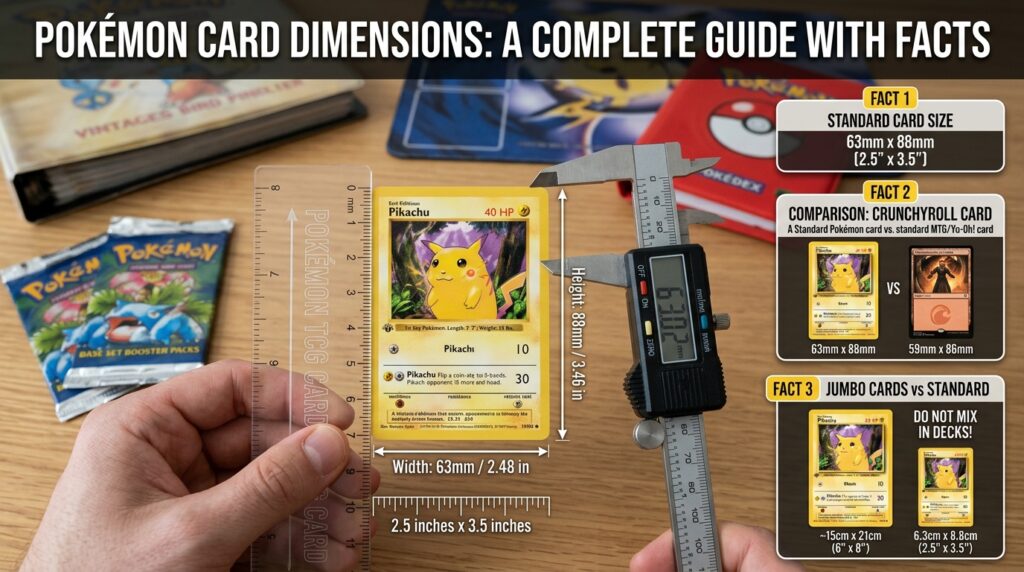
This guide dives deep into everything related to Pokémon Card Dimensions, measurements, thickness, weight, sleeves, storage, grading, and protection.
Whether you’re building your first deck, preserving vintage treasures, or trying to understand the technical side of the Pokémon Trading Card Game (TCG), you’ll find practical information here that goes beyond basic numbers.
| Pokémon Card Specification | Size |
|---|---|
| Standard Card Width | 2.5 in (63.5 mm) |
| Standard Card Height | 3.5 in (88.9 mm) |
| Card Thickness | 0.012 in (0.305 mm) |
| Card Weight | ~1.78 g |
| Aspect Ratio | 5:7 |
| Corner Radius | ~0.125 in (3.18 mm) |
| Sleeve Size | 2.64 × 3.58 in (67 × 91 mm) |
| Toploader Size | 3 × 4 in (76 × 101 mm) |
| Oversized Card Size | 5 × 7 in (127 × 178 mm) |
Quick Fact: Standard Pokémon cards measure 2.5 × 3.5 inches (63.5 × 88.9 mm), the same size as most major trading cards.
What Are the Official Pokémon Card Dimensions?
The official Standard Pokémon Card Size used in the modern Pokémon TCG is:
- 2.5 × 3.5 inches
- 63.5 × 88.9 mm
- 5:7 Aspect Ratio
These measurements apply to nearly all standard tournament legal cards, including:
- Basic Pokémon Card
- Evolution Pokémon Card
- Trainer Card
- Item Card
- Supporter Card
- Energy Card
- Special Energy Card
- Stadium Card
This consistency isn’t accidental. The dimensions were chosen because they fit comfortably in a player’s hand while allowing artwork, game text, and battle information to remain readable.
It sounds simple enough, but getting this balance right was probably harder than teaching a Magikarp to stop flopping around.
When people search for pokemon card size, pokemon card measurements, or exact pokemon card size, these are the numbers they’re looking for.
Understanding Pokémon Card Width and Height
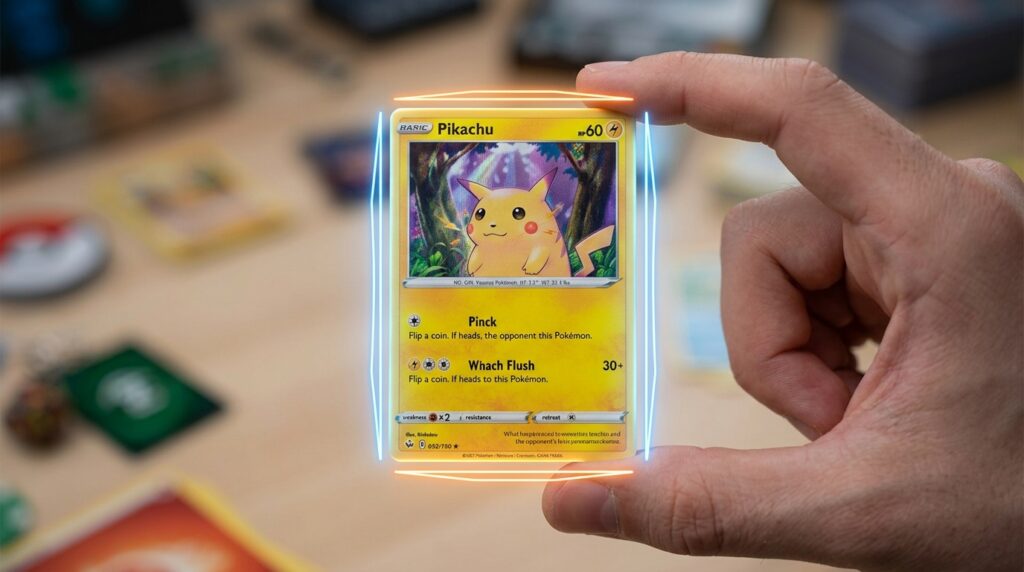
The two most important measurements are width and height.
Pokémon Card Width
The standard Pokémon Card Width is:
- 2.5 inches
- 63.5 mm
This width allows cards to stack neatly while remaining easy to shuffle. A card much wider would feel awkward. A card much narrower would make artwork look cramped.
Pokémon Card Height
The official Pokémon Card Height is:
- 3.5 inches
- 88.9 mm
The height creates enough room for:
- Character artwork
- HP values
- Attack descriptions
- Energy requirements
- Ability text
- Collector information
It’s one of those dimensions that seems ordinary until you compare it with other trading card games.
Pokémon Card Dimensions Compared to Other Trading Card Games
Collectors often wonder about trading card size comparison options.
Here’s a simple overview:
| Game | Dimensions |
|---|---|
| Pokémon TCG | 2.5 × 3.5 inches |
| Magic: The Gathering | 2.5 × 3.5 inches |
| Yu Gi Oh! | 2.32 × 3.37 inches |
| KeyForge | 2.5 × 3.5 inches |
This means pokemon vs magic the gathering cards is actually a very easy comparison because both use identical dimensions.
However, pokemon vs yugioh card size reveals a noticeable difference. Yu Gi Oh! cards are slightly smaller, which explains why sleeves made for Pokémon cards often feel loose when used on Yu Gi Oh! cards.
Pokémon Card Thickness Explained
Many collectors focus on height and width while forgetting thickness.
The standard Pokémon Card Thickness is approximately:
- 0.012 inches
- 0.305 mm
This measurement can vary slightly depending on:
- Printing era
- Manufacturing location
- Foil treatments
- Promotional releases
A few thousandths of an inch might sound insignificant, but experienced graders can sometimes detect unusual thickness immediately.
Understanding pokemon card thickness is important for both authentication and preservation.
How Much Does a Pokémon Card Weigh?
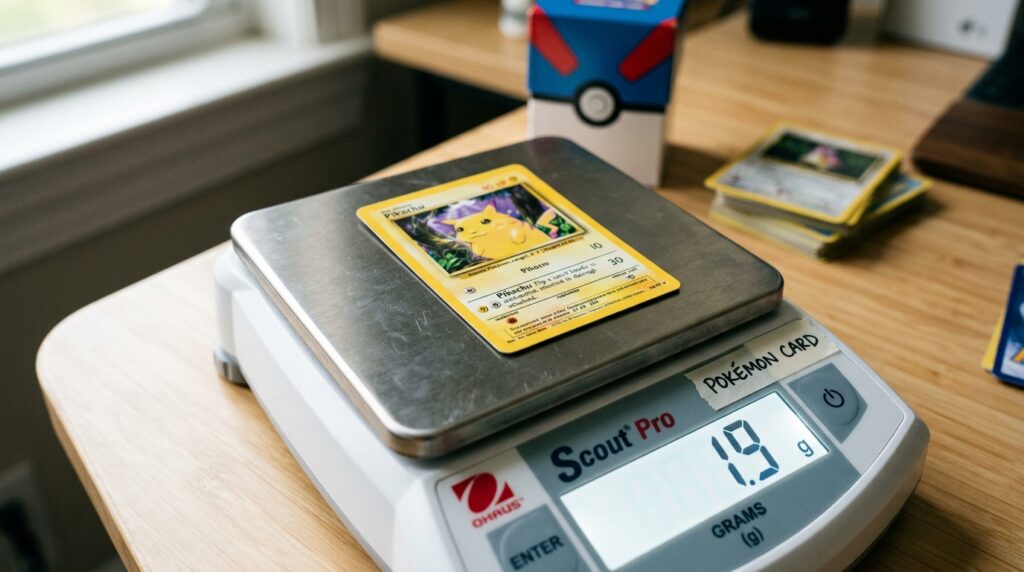
Standard cards generally weigh around:
- 1.78 g
This figure may change slightly depending on:
- Foil layers
- Card condition
- Manufacturing variations
The Card Weight becomes surprisingly useful during Counterfeit Detection. Some fake cards weigh noticeably less or more than authentic versions.
Professional graders occasionally use precision scales when investigating suspicious submissions.
Pokémon Card Materials and Construction
A Pokémon card looks simple from the outside, but it’s actually a layered product.
Typical construction includes:
- High quality Cardstock
- Printed surface layers
- Internal core layers
- Protective coatings
Premium cards may additionally include:
- Foil Layering
- Holographic Foil
- Texture patterns
The famous Holographic Charizard cards are perfect examples of how additional materials create visual effects that collectors adore.
The overall cardstock quality directly influences Card Durability and long-term preservation.
Pokémon Card Dimensions and Tournament Play
In official Tournament Play, card dimensions matter more than many players realize.
Cards that are:
- Excessively warped
- Modified
- Trimmed
- Damaged
may become problematic during events.
Official judges expect cards to match standard Trading Card Specifications.
This helps maintain fairness during competitive matches and prevents players from accidentally identifying specific cards while shuffling.
For serious Deck Building, consistency matters. Even tiny physical differences can affect gameplay.
Pokémon Card Sleeve Size Guide
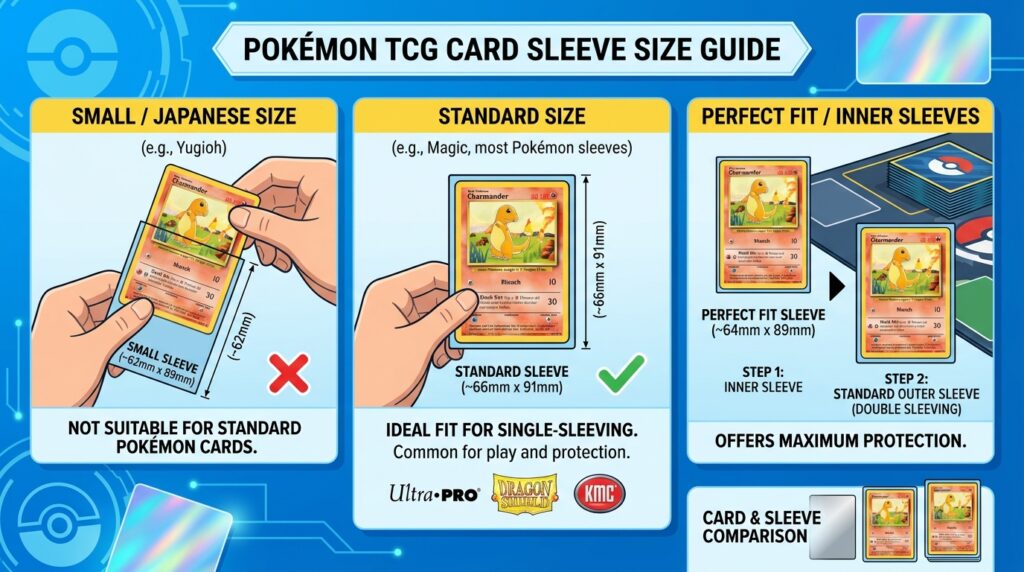
One of the most searched questions involves Pokémon Card Sleeve Size.
The most common sleeve size is:
- 66 × 91 mm
These sleeves comfortably fit the standard card dimensions while leaving minimal extra space.
Collectors frequently search for:
- pokemon card sleeve size
- best sleeves for pokemon cards
- premium card sleeves
Popular sleeve choices include products from Dragon Shield and Ultra Pro Eclipse.
Both brands are respected among competitive players and collectors because they offer excellent protection without making decks feel bulky.
Penny Sleeves
Penny Sleeves are:
- Affordable
- Lightweight
- Great for storage
Many collectors place valuable cards in penny sleeves before using additional protection.
Premium Sleeves
Premium Sleeves provide:
- Better durability
- Improved shuffle feel
- Enhanced protection
These are often preferred for tournaments.
Pokémon Card Toploader Size
If you’ve ever bought a valuable card online, chances are it arrived inside a rigid plastic holder.
The standard Pokémon Card Toploader Size is designed for standard trading cards measuring:
- 2.5 × 3.5 inches
Common protection setups include:
- Penny Sleeve + Toploader
- Premium Sleeve + Toploader
These combinations are excellent for shipping rare cards.
Collectors frequently use:
- Toploaders
- Rigid Card Holders
- Toploader Storage Box
to safeguard high value collectibles.
Binder Pocket Size and Storage Solutions
Storage may not sound exciting, but ask any long-term collector and they’ll tell you that poor storage causes heartbreak.
A bent corner on a vintage card can feel oddly painful, almost like finding a scratch on a favorite old photograph.
Binder Pocket Size
Most collectors use:
- 9 Pocket Pages
- Standard Binder Pockets
These pockets are specifically sized for standard Pokémon cards inside sleeves.
Popular storage methods include:
- Binder collections
- Deck organizers
- Storage boxes
- Display cases
Good Trading Card Storage habits dramatically improve long-term condition.
Pokémon Card Storage Best Practices
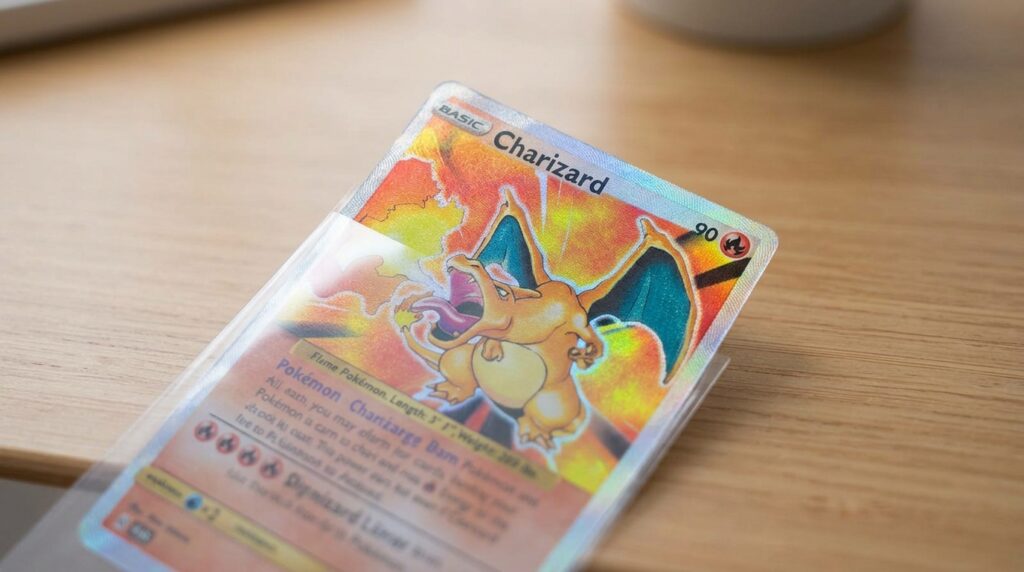
Effective Pokémon Card Storage isn’t complicated.
A few simple habits make a huge difference.
Use a Deck Box
A Deck Box protects active decks from bending and scratching.
Store Valuable Cards Properly
Use:
- Penny Sleeves
- Premium Sleeves
- Toploaders
for expensive cards.
Maintain Stable Conditions
Serious collectors often use Climate Controlled Storage to avoid:
- Humidity damage
- Warping
- Mold growth
Organize Efficiently
A dedicated Storage Box helps manage larger collections while reducing accidental damage.
Proper Pokemon Collection Management becomes increasingly important as collections grow.
Oversized Pokémon Cards and Jumbo Cards
Not every Pokémon card follows standard dimensions.
Oversized Pokémon Cards, often called Jumbo Pokémon Cards, are promotional collectibles produced in larger formats.
These cards frequently appear in:
- Special Collection Box
- Premium collections
- Anniversary products
Because dimensions vary, standard sleeves and binders usually won’t fit them.
Collectors often purchase specialized oversized binders to store these giant versions safely.
Japanese Pokémon Cards vs English Pokémon Cards
A question that pops up more than people expect is whether Japanese Pokémon Cards and English Pokémon Cards have different dimensions.
The answer is generally no.
Both versions use the same standard dimensions:
- 63.5 × 88.9 mm
- 2.5 × 3.5 inches
Differences are usually found in:
- Print quality
- Texture
- Language
- Release schedules
Not size.
That’s good news because the same sleeves and storage products work for both.
Pokémon Card Authentication and Counterfeit Detection
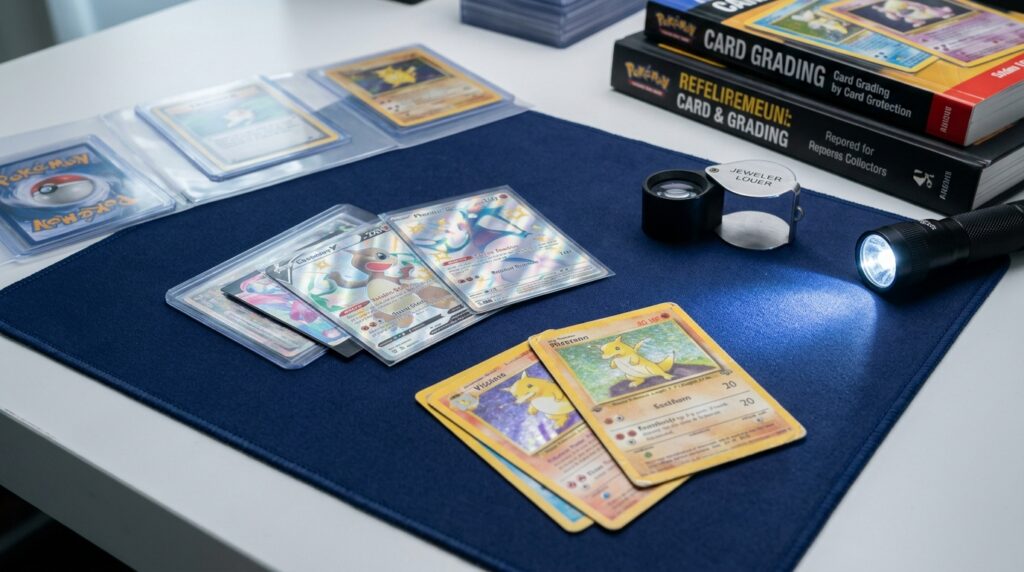
Knowing Pokémon Card Specifications can help identify fakes.
Common warning signs include:
- Incorrect dimensions
- Unusual thickness
- Incorrect weight
- Poor printing quality
- Strange coloring
Effective Counterfeit Pokémon Card Detection often begins with simple measurements.
Collectors pursuing Pokémon Card Authentication frequently compare suspect cards against known authentic examples.
This is where precise dimensions become surprisingly powerful.
Pokémon Card Grading and Dimensions
Professional grading companies examine every detail.
Popular grading services include:
- PSA
- Beckett
The process of Card Grading evaluates:
- Corners
- Surface quality
- Centering
- Edges
- Authenticity
Whether you’re submitting a vintage Blastoise, a rare Mewtwo, or an iconic Charizard, proper measurements help establish legitimacy.
Searches for:
- pokemon card grading
- psa grading
- beckett grading
continue growing as more collectors view cards as long-term collectibles.
Pokémon Card Products and Packaging
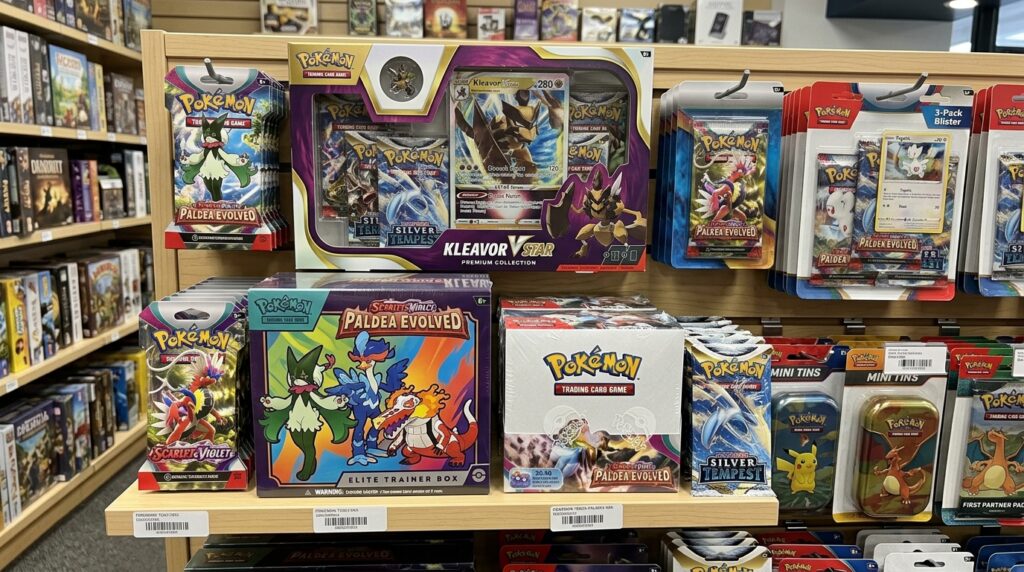
Cards reach players through many products.
Common examples include:
Booster Pack
A Booster Pack contains randomized cards and remains the most popular purchase option.
Elite Trainer Box (ETB)
The Elite Trainer Box (ETB) usually includes:
- Booster packs
- Sleeves
- Dice
- Storage accessories
Theme Deck
A Theme Deck provides a ready to play experience for beginners.
Battle Deck
A Battle Deck offers stronger competitive options.
Special Collection Box
A Special Collection Box often contains promo cards and exclusive collectibles.
No matter where the card comes from, standard dimensions remain remarkably consistent.
Fascinating Pokémon Card Facts
Here are a few facts many collectors don’t know.
- Pokémon cards share dimensions with several major trading card games.
- The standard size has remained largely unchanged for decades.
- Thickness measurements help detect counterfeit cards.
- Sleeve manufacturers design products around precise card dimensions.
- Oversized promotional cards intentionally break standard sizing rules.
- Card grading companies rely on physical measurements during evaluation.
- Storage quality can affect collector value as much as rarity.
- A damaged rare card may lose substantial value despite remaining authentic.
Little details matter more than most people expect.
Why Pokémon Card Dimensions Matter More Than You Think
At first glance, Pokémon Card Dimensions seem like a dry topic. Just numbers on a page. Width, height, thickness, weight. Nothing exciting there, right?
But then you think about what those measurements actually support.
They allow smooth gameplay.
They make tournaments fair.
They ensure sleeves fit properly.
They help collectors preserve memories.
They help grading companies authenticate treasures.
And perhaps most importantly, they connect millions of cards printed across decades into one consistent system.
A card pulled from a modern booster today sits beside a vintage favorite from years ago and still feels like it belongs.
That’s kinda beautiful in a strange way.
Frequently Asked Questions
What are the official Pokémon card dimensions?
The official Pokémon card dimensions are 2.5 × 3.5 inches (63.5 × 88.9 mm). This is the standard size used for most Pokémon TCG cards worldwide.
How thick is a standard Pokémon card?
A standard Pokémon card is approximately 0.012 inches (0.305 mm) thick. Slight variations may occur depending on the card’s age, printing process, or holographic features.
What size sleeves fit Pokémon cards?
The recommended Pokémon card sleeve size is usually 66 × 91 mm. These sleeves provide a comfortable fit while protecting cards from scratches and wear.
Are Japanese Pokémon cards the same size as English Pokémon cards?
Yes, Japanese Pokémon cards and English Pokémon cards have the same standard dimensions of 63.5 × 88.9 mm, making them compatible with the same sleeves and binders.
Why are Pokémon card dimensions important?
Knowing the correct Pokémon card dimensions helps with card protection, storage, grading, authentication, and choosing the right accessories such as sleeves, binders, and toploaders.
Read this Blog: https://zyrovexa.com/4-inches/
Conclusion
Understanding Pokémon Card Dimensions gives collectors and players a deeper appreciation for the hobby.
The standard size of 2.5 × 3.5 inches (63.5 × 88.9 mm) may look simple, yet it influences everything from gameplay and storage to grading and authentication.
Whether you’re organizing a binder full of rare cards, protecting a prized Holographic Charizard, building a tournament deck, or learning the basics of Pokémon Card Collecting, knowing the correct dimensions helps you make smarter decisions.
The next time you pick up a Pokémon card, take a second to notice its shape. Not just the artwork. Not just the rarity. The dimensions themselves.
They’re part of the reason the hobby works so well, and after all these years, they remain one of the quiet foundations of the entire Pokémon universe.