

Introduction
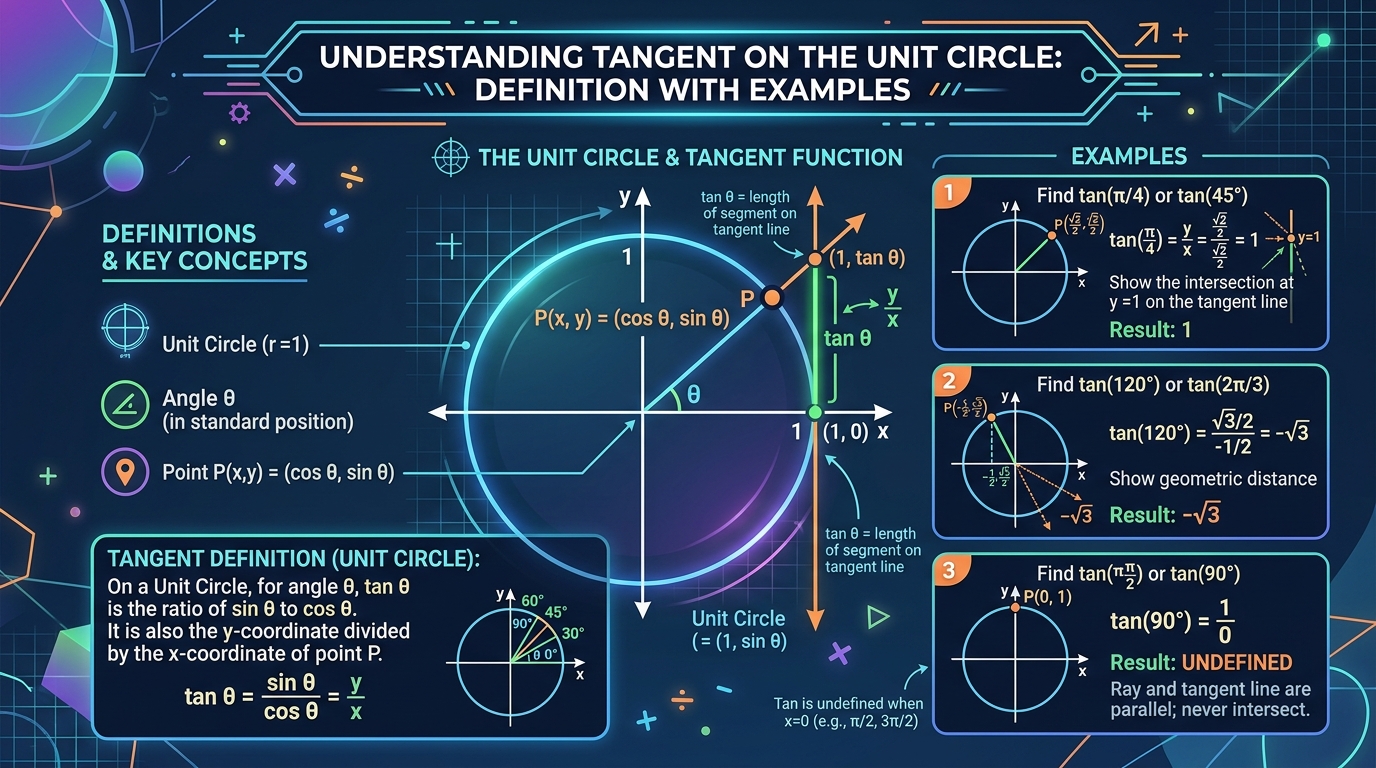
There are moments in mathematics when a single picture quietly explains what pages of formulas struggle to say. The Unit Circle With Tangent is one of those rare ideas.
At first glance, it looks like nothing more than a simple circle resting on a graph, yet inside that humble drawing lives a complete story of angles, motion, patterns, and relationships.
Funny thing is, loads of students meet it in the classroom and think, “Well… this seems way more confusing than it probably is.” And honestly, thats a fair reaction.
I still remember watching a teacher draw a circle centered perfectly at the origin and then casually sketch a vertical line touching the circle.
Everyone copied it into their notebooks without really knowing why that lonely line mattered so much. A week later, after solving several trigonometry problems, the picture suddenly made sense. It wasn’t just a circle anymore it had become a map.
Whether you’re preparing for exams, brushing up on forgotten math skills, or simply curious about Mathematics, understanding the Unit Circle With Tangent can make many Trigonometric Functions feel surprisingly natural.
Instead of memorizing endless values, you’ll begin seeing patterns, and maths kinda becomes less stubborn than it first appears.
In this guide, we’ll explore the Unit Circle Definition, explain how the Tangent Function fits into it, work through examples, discuss common mistakes, and provide practical exercises that help the concepts stay in your memory long after the lesson ends.
| Feature | Details |
|---|---|
| Definition | The unit circle is a circle with radius 1, and tangent is found using tan θ = sin θ / cos θ. |
| Formula | tan θ = y/x = sin θ ÷ cos θ |
| 0° | tan(0°) = 0 |
| 45° | tan(45°) = 1 |
| 60° | tan(60°) = √3 ≈ 1.732 |
| 90° | tan(90°) is undefined because cos(90°) = 0. |
What Is the Unit Circle?
Before discussing tangent, it’s important to understand what the Unit Circle actually is.
The Unit Circle is a Circle with a Radius = 1, centered at the Origin, which is the point (0,0) in the Cartesian Coordinate System or Coordinate Plane.
This means every point lying on the circle is exactly one unit away from the center. Seems almost too simple, but thats exactly why mathematicians love it.
The standard equation is:
[
x^2+y^2=1
]
Every point on this circle represents an angle measured from the Positive x-axis.
As the angle increases, the point rotates around the circle in a Counterclockwise Rotation, producing new coordinates that represent the trigonometric values.
The coordinates of every point are written as:
[
(\cos\theta,\sin\theta)
]
Here:
- cos θ = x-coordinate
- sin θ = y-coordinate
This elegant relationship is the foundation of nearly all Trigonometry.
Unit Circle With Tangent Explained
Now comes the interesting part.
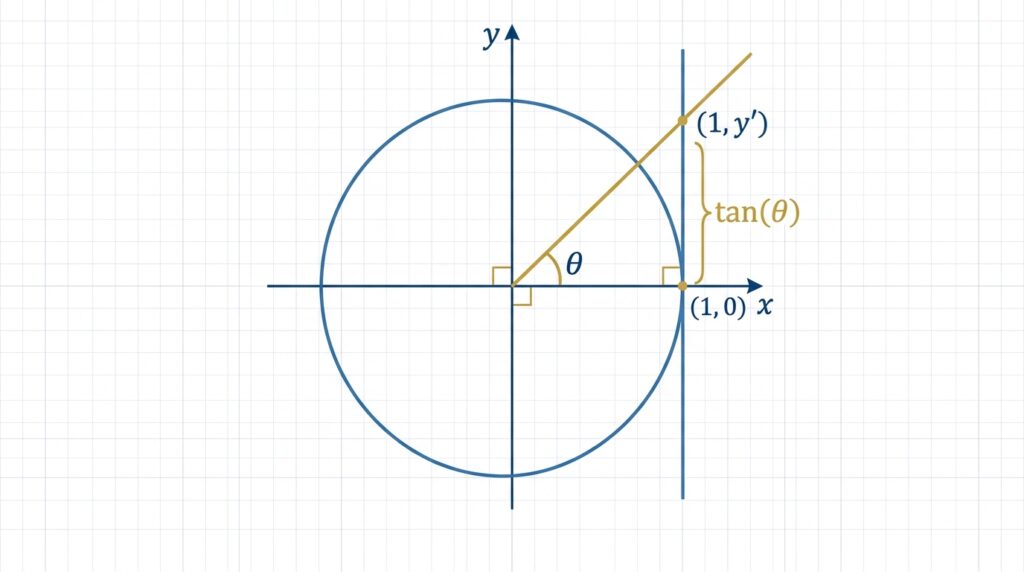
The Unit Circle With Tangent introduces a vertical line touching the circle exactly once.
That touching line is called the Tangent, and unlike the radius, it doesn’t pass through the center. Instead, it gently kisses the circle at one point and then keeps stretching forever. Bit poetic for geometry, maybe, but its true.
The Tangent Trigonometric Function measures something very specific.
Instead of using the coordinates directly, tangent compares them using the equation:
[
\tan\theta=\frac{\sin\theta}{\cos\theta}
]
This is known as the Tangent Ratio.
Because:
- sin θ = y coordinate
- cos θ = x coordinate
the tangent becomes:
[
\tan\theta=\frac{y}{x}
]
This simple fraction reveals the Slope created by the angle.
Why the Tangent Function Matters on the Unit Circle
Many students memorize tangent values without understanding where they come from. That usually works… until exam questions start looking unfamiliar.
The Tangent Function has several important uses:
- It measures the Slope Interpretation of an angle.
- It connects Geometry with Algebra.
- It helps solve right triangles.
- It appears in engineering and physics.
- It models Rotational Motion and Circular Motion.
- It is essential for calculus.
- It simplifies many Mathematical Problem Solving situations.
- It forms the basis for several Trigonometric Identity equations.
A math professor once joked during a lecture:
“Students don’t usually fear tangent. They fear forgetting where cosine went.”
That tiny joke actually captures the biggest misunderstanding perfectly.
Unit Circle With Tangent and Standard Angles
The beauty of the unit circle lies in repeating patterns.
Here are several important Standard Angles.
| Angle | Coordinates | Tangent |
|---|---|---|
| θ = 30° | (√3/2, 1/2) | 1/√3 |
| θ = 45° | (√2/2, √2/2) | tan 45° = 1 |
| θ = 60° | (1/2, √3/2) | √3 |
| θ = 90° | (0,1) | Undefined tangent |
Notice something?
At θ = 90° or π/2, the x-coordinate becomes zero.
Since
[
\tan\theta=\frac{\sin\theta}{\cos\theta}
]
we get
[
\frac{1}{0}
]
Division by zero isn’t possible.
Therefore:
tan 90° = Undefined
Sometimes people describe it as approaching an Infinite Tangent, but mathematically we simply call it Undefined.
Understanding Angles in Degrees and Radians
Every angle on the unit circle can be measured in two ways.
The first uses Degrees.
The second uses Radians.
Some common conversions include:
| Degrees | Radians |
|---|---|
| 30° | π/6 |
| 45° | π/4 |
| 60° | π/3 |
| 90° | π/2 |
| 180° | π |
Learning both systems makes Angle Measurement much easier because university level mathematics relies heavily on radians.
Visualizing the Unit Circle
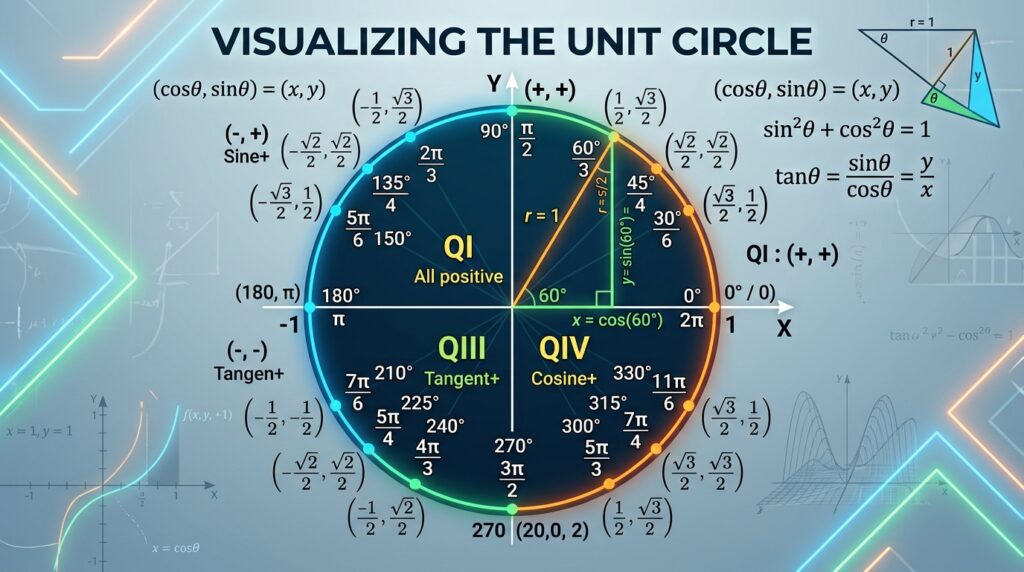
Imagine standing at the center of a merry go round.
As you slowly rotate, your position changes continuously.
Every rotation creates a new Coordinate Point.
Those coordinates instantly produce:
- Sine
- Cosine
- Tangent
Rather than memorizing dozens of values, you begin seeing the movement itself. That mental picture sticks around longer than flashcards, least it did for me.
This process improves:
- Visualization
- Pattern Recognition
- Understanding Trigonometry
- Learning Mathematics
Examples of Tangent on the Unit Circle
Examples usually remove the mystery.
Example 1
Find tangent when:
θ = 45°
Coordinates:
[
(\sqrt2/2,\sqrt2/2)
]
Calculation:
[
\tan45^\circ=
\frac{\sqrt2/2}{\sqrt2/2}=1
]
Answer:
tan 45° = 1
Example 2
Find tangent when:
θ = 30°
Coordinates:
[
(\sqrt3/2,1/2)
]
Calculation:
[
\tan30^\circ=
\frac{1/2}{\sqrt3/2}
=\frac1{\sqrt3}
]
Answer:
[
\frac1{\sqrt3}
]
Example 3
Find tangent for:
θ = 90°
Coordinates:
(0,1)
Calculation:
[
\frac10
]
Answer:
Undefined.
The tangent does not exist because the denominator equals zero.
The Relationship Between Sine, Cosine, and Tangent
The three major Trigonometric Functions are deeply connected.
Think of them as teammates rather than separate formulas.
- Sine measures vertical movement.
- Cosine measures horizontal movement.
- Tangent compares both movements.
That relationship is written as:
[
\tan\theta=
\frac{\sin\theta}{\cos\theta}
]
Understanding this one identity often makes dozens of later lessons easier.
Common Mistakes Students Make

Even bright learners trip over the same ideas.
Here are frequent mistakes:
- Forgetting that the Unit Radius equals exactly one.
- Mixing up Degrees with Radians.
- Writing coordinates backwards.
- Forgetting that coordinates are (cos θ, sin θ).
- Trying to divide by zero.
- Confusing the tangent line with the tangent ratio.
- Ignoring quadrant signs.
- Memorizing values without understanding the geometry.
A classroom teacher once said, “Patterns beat memorization every single semester.” Thats surprisingly solid advice.
Unit Circle With Tangent Practice Problems
Practice transforms understanding into confidence.
Try solving these yourself.
- Find tan θ when θ = 60°.
- Find the coordinates for θ = 30°.
- Explain why tan 90° is undefined.
- Convert π/3 into degrees.
- Calculate tangent using sin θ and cos θ.
- Identify the Slope represented by θ = 45°.
- Sketch a simple Unit Circle Diagram showing the tangent line.
- Compare the tangent values in Quadrants I and III.
Working through these regularly helps prepare for homework, quizzes, and competitive exams.
Helpful Tips for Memorizing the Unit Circle
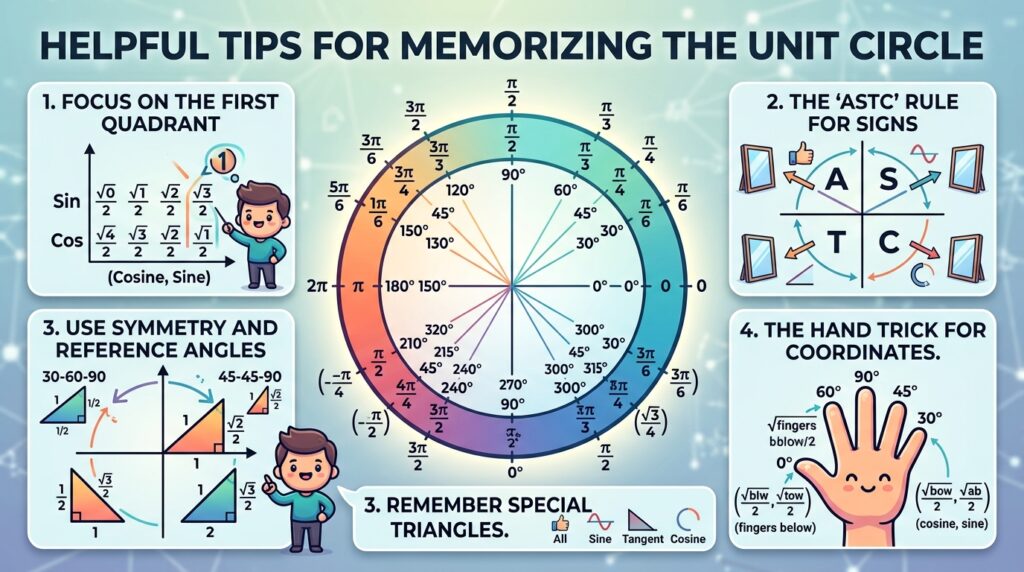
Memorization doesn’t have to feel painful.
Try these techniques:
- Draw the circle every day for one week.
- Learn one quadrant before moving to the next.
- Practice converting Degrees into Radians.
- Color-code Sine, Cosine, and Tangent values.
- Build your own Unit Circle Chart.
- Solve a few Examples daily.
- Explain the concepts to another Student.
- Use visualization rather than rote memorization.
You’ll probably notice that after enough repetition, the numbers begin feeling familiar instead of random.
Applications in Real Life
Although it may seem abstract, the Unit Circle With Tangent appears in many practical fields.
Engineers use it when studying rotating machinery.
Architects rely on trigonometric calculations while designing structures.
Computer graphics use Coordinate Geometry for animation.
Physicists model waves and Circular Motion using trigonometric relationships.
Surveyors calculate distances and elevations.
Navigation systems depend on angular measurements.
Even video game developers quietly lean on these mathematical ideas when characters rotate, move, or aim in different directions. Funny how a classroom diagram ends up inside a game engine, isnt it?
Frequently Asked Questions
What is the unit circle?
It is a circle with a Unit Radius centered at the origin (0,0).
What is tangent in the unit circle?
The Tangent Function equals:
[
\tan\theta=
\frac{\sin\theta}{\cos\theta}
]
It represents the slope created by the angle.
Why is tangent undefined at 90 degrees?
Because cos θ = 0, and division by zero is impossible.
Why are radians important?
Radians naturally describe rotations and simplify higher-level mathematics.
Do I need to memorize the unit circle?
Understanding patterns is more valuable than memorizing every value, although repeated practice certainly helps.
Frequently Asked Questions
1. What is the tangent on the unit circle?
Tangent is the ratio of the y-coordinate to the x-coordinate on the unit circle. It is also equal to sin θ ÷ cos θ.
2. Why is tangent undefined at 90°?
At 90°, the cosine value is 0. Since division by zero is impossible, the tangent is undefined.
3. How do you find tangent using the unit circle?
Locate the angle on the unit circle, identify its sine and cosine values, then divide sine by cosine to get the tangent.
4. What is the tangent value at 45°?
The tangent of 45° is 1 because the sine and cosine values are equal at that angle.
5. Why is the unit circle important for tangent?
The unit circle helps you quickly determine tangent values for common angles and understand where tangent is positive, negative, or undefined.
Read this Blog: https://zyrovexa.com/what-is-80-degrees-fahrenheit-in-celsius/
Conclusion
Learning the Unit Circle With Tangent is less about collecting formulas and more about recognizing relationships.
Once you understand that every point on the circle represents Sine, Cosine, and the Tangent Ratio, the subject begins to unfold in a logical way instead of feeling like a stack of disconnected rules.
Sure, there’ll still be moments where an equation looks a bit grumpy, but thats part of learning any worthwhile skill.
Remember that the Unit Circle is more than a diagram. It is a visual language connecting Geometry, Algebra, Mathematics, and the broader world of Trigonometry.
From Angle Rotation to Coordinate Geometry, from classroom exercises to engineering applications, the same elegant principles continue to appear again and again.
Keep sketching the circle, revisit the Unit Circle Coordinates, practice the Trigonometric Ratios, and solve plenty of examples. Little by little, what once seemed difficult starts feeling almost familiar.
If you have your own memory trick, favorite practice method, or a question about the Unit Circle With Tangent, share it with others sometimes the simplest explanation from another learner is the one that finally makes everything click.